
Different time zones
Your morning starts later than the market.
From Hawaiʻi to the West Coast, your day doesn’t have to begin at the opening bell. A scheduled server setup can run while you’re away.
$1 = up to $2 of the Nasdaq-100 while its trend is up, T-bills when it breaks.
The Distillate holds more of the NASDAQ when markets are calm and less when they are violent, steps fully aside in confirmed downtrends, and runs with real money — in public.
Drag the dial. See why bigger swings mean less exposure.
Concept only, not actual sizing. The trend exit can also take exposure to zero.
Volatility measures market movement, not investment return. The animated line is illustrative.
We do not search for strategies that work. We search for reasons they do not. One hundred and eighty-seven searches, and counting, found one.
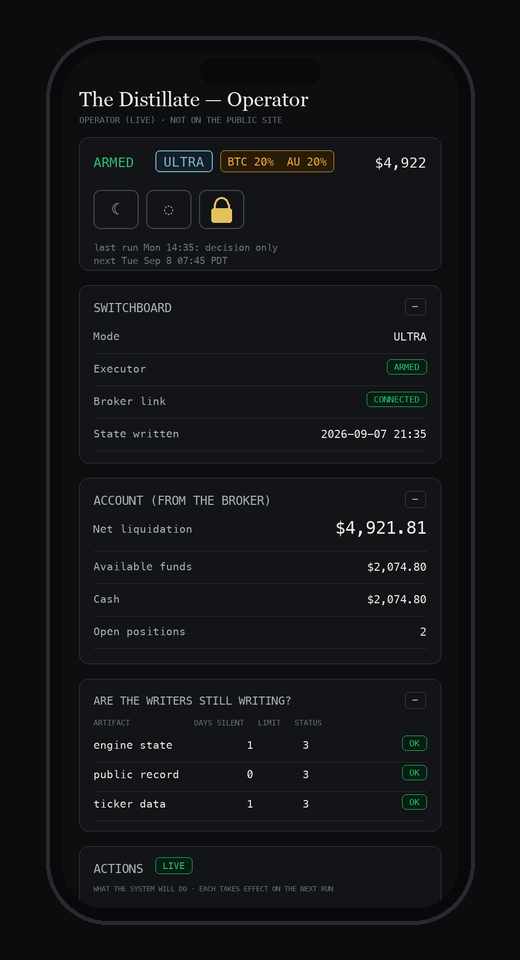
The engine runs on your own computer. The operator is the one screen you open to check on it, from the couch or from the other side of the world, and it tells you the verdict before anything else.
How to set it up and put it on your phone →
Included with every licence. The screen above is the author’s own operator, taken tonight.
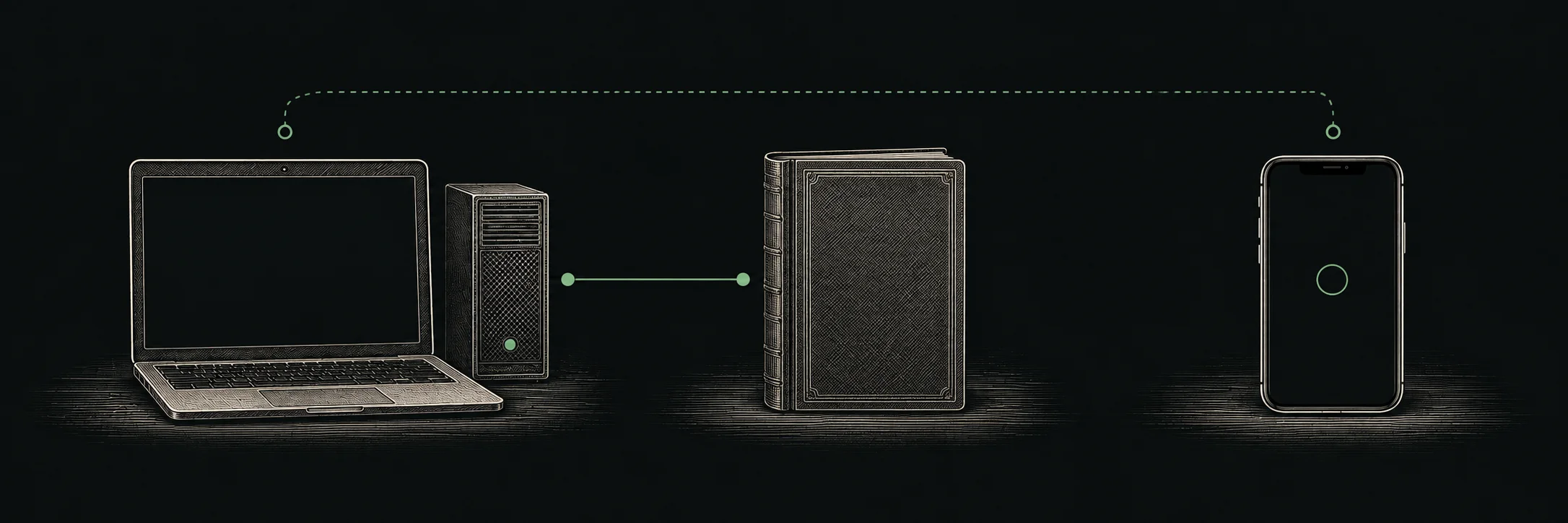
A daily investing routine. Room for everything else.
From Hawaiʻi to the West Coast, your day doesn’t have to begin at the opening bell. A scheduled server setup can run while you’re away.
Meetings, shifts, classes, family. The Distillate follows its daily rules without asking you to watch charts throughout the day.
Defined rules, a scheduled routine, and a record you can inspect. For people who prefer consistency to making another market call.
You remain responsible for keeping the setup connected, responding to broker authentication requests, and checking alerts. Investments can lose value.
Running it on your own computer? It must be awake and connected for scheduled runs. A server handles that separately.
See what the setup needsNothing here asks for your attention during the day. The machine runs after the close and the record publishes itself. What it does ask for is below.
The evidence is on the research page; this is the decision it supports. Pick an engine — the name is your configuration, and the record page always shows which one is live.
The engine is the strategy itself — how much market exposure the volatility rule holds, and in what. Full cycle means every year since these funds existed, crashes included; since 2009 is the bull era on its own; worst is the deepest fall from a high before the account got back to it.
swipe for all columns →
| engine | what it holds | full cycle 1999–2026 | since 2009 |
|---|---|---|---|
| STEADY | S&P + NASDAQ + gold, each with the monthly trend exit | 11.7%/yr · worst −18% | 13.8%/yr |
| SELECT | NASDAQ only, monthly trend exit | 14.7%/yr · worst −21% | 18.5%/yr |
| ULTRA | NASDAQ only, hotter calibration, same exit | 17.3%/yr · worst −27% | 22.2%/yr |
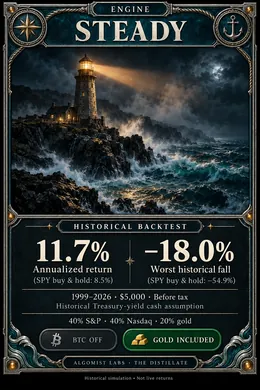
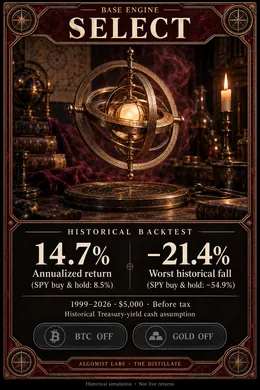
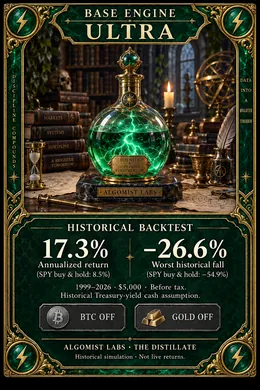
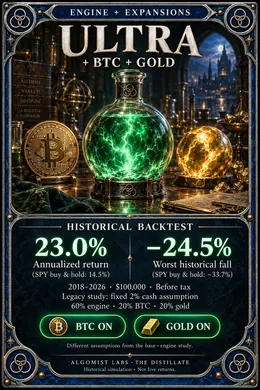 The four configurations, as cards →
STEADY had no losing decade, including the dot-com crash. All three engines share one exit rule and differ only in what they hold and how hard they run it. STEADY’s gold sleeve is a gold fund held without leverage; in a taxable account the IRS taxes gold funds as collectibles, 28% long-term instead of 20%, so its after-tax edge is a little smaller than the pre-tax one. Gold before August 2000 is modelled from monthly prices, because that is where daily history begins.
Small accounts are not a compromise: the same code at every size, measured. The ladder, the futures research and the small-account sweep →
Deposits rebalance for free. The engine re-reads your actual positions before every decision, so new cash simply lowers your measured exposure and the next run buys toward target — a rebalance with no sale, no commission on the way out, and no tax event. Adding money is not just fuel; it is the cheapest rebalancing the strategy ever does.
Every popular strategy we tested — on millions of simulated trades, with honest fills and real costs — and closed with documented evidence. The audit is the product's pedigree.
The gate works in both directions. Three candidates sit on parole right now — including dealer gamma exposure (GEX), which we tested eight ways and refuted as a trade every time, before finding the one narrow thing it does well. That survivor is still being tested and still changes nothing. Nothing enters the engine the easy way, including the ideas we like.
A strategy that doesn't change shouldn't bill monthly — at $29/month, a $10,000 account pays $348 a year — more than its full-cycle STEADY edge over simply holding the index, and roughly two-thirds of ULTRA’s. We refuse to sell that. The live record began Aug 25, 2026, so the launch price reflects that: founding licenses are $149 for the first 25 licences, then $199, with the server set up for you; $99, then $149, on your own computer. Buy early, pay less, keep lifetime updates.
The engine, one price, three dials included. STEADY, SELECT and ULTRA are one rule at three appetites, so they are one licence. Expansions come with the licence. Each is another return stream, validated on its own, and arrives as a switch, off until you turn it on, the day it clears its gate on the expansions page. No add-on purchases: improvements and expansions alike reach every licence.
Same strategy. Two ways to run it. Most people should take the server: it runs while your laptop is closed, nothing is missed, and the Algo-wizard sets it up in about ten minutes. The licence alone is for people who want it on their own machine. Both start in dry-run; you deliberately arm real orders. The refund window closes when you accept the software invitation.
Both include the full licence: STEADY, SELECT and ULTRA, the TradingView companion, and lifetime software updates. Expansions come with it too, as switches, as each clears its gate.
On a rented server · the licence + $100 for the server setup
Founding price for the first 25 licences · then $199
The wizard does the setup; email support if anything stalls before your first armed trade. Hosting is about $12/month extra, paid to DigitalOcean: approximately $293 total in year one for licence, setup and hosting.
Get it running — $149See what the server setup involves →
The licence alone · you run it on your own machine
Founding price for the first 25 licences · then $149
Your machine handles the scheduled run. No server rental is required.
Licence only — $99See what setup looks like, step by step →
The same rule, running in your Robinhood agent account
| Interactive Brokers | Robinhood | |
|---|---|---|
| Available | Now | Now · live in the founder’s account since Sept 30 |
| Setup | A rented server (about $12/month) or your own computer, plus IBKR’s gateway | Double-click setup, no gateway: a one-time sign-in. Runs on your computer or a small server |
| Logins | Approve IBKR’s weekly login on your phone | None after the first |
| Trading fees | IBKR’s per-order commission | $0 |
| Shares | Whole shares | Fractional |
| Smallest account | At least $2,000 | From about $250 (tested on 27 years of history) |
| What it runs | The engine, plus the bitcoin and gold switches | The Nasdaq engine; the switches come later |
| Your money | Your own IBKR account | A separate Robinhood agent account you fund |
In the package: double-click Robinhood Setup. Not affiliated with Robinhood.
Advertising disclosure: we earn a commission at no additional cost to you when you shop through the links below.
Most people buying the server option have never had a server, so here is the whole of it before you pay for anything. A server is a computer you rent by the month that lives in a data centre and never sleeps. That is the entire idea — your laptop closes, this does not. You rent it yourself and pay the host directly; we never touch it.
The Algo-wizard rents it for you. One command on your own computer makes a DigitalOcean account’s API token into a running server: 2 GB, Ubuntu, about $12 a month, billed by the hour until you delete it. It shows you the exact plan and price and asks before creating anything, copies itself across, installs Interactive Brokers’ gateway, takes your broker login once (typed hidden, never seen by us), and puts the console on your phone. You never type on the server.
Any host works: Hostinger, Lightsail, Vultr, or anything that rents Ubuntu with 2 GB, by hand, and the guide walks that path too. We automated DigitalOcean first because its API is simple enough to drive from one command, its control panel is the friendliest we have seen for a first server, and it bills by the hour, so a mistake costs cents. That is the whole reason. We are not paid to prefer it, though we earn a commission if you sign up through our link.
After that it is roughly a minute a week — tapping approve on your phone when Interactive Brokers signs everyone out on Sunday. If nobody taps, it waits. It does not trade badly, it just does not trade.
If that still sounds like more than you want to do, that is what the Algo-wizard is for: one command, and it is done.
Excess return over buy & hold at the historical rates, on a $5,000 account: roughly $436 a year on ULTRA, $309 on SELECT, $159 on STEADY — excess, not total return, against a one-time price. If your account is small enough that those months look long, don't buy it: the live record is free to watch forever, and watching costs nothing but patience.
No. It runs on your computer against your own Interactive Brokers account, using credentials you type and we never see. We have no access to your account, cannot place a trade in it, and cannot withdraw from it. There is nothing to trust us with.
Disarm it. That takes one click or one command and it goes back to reporting without trading. Your positions stay exactly as they are — stopping the software does not liquidate anything. You decide what to do with what you hold.
About fifteen minutes once on your own computer (twenty if IB Gateway still has to be installed), or about ten minutes once for a rented server (one command rents it and sets it up), then a minute a week. Both are written out step by step, with the screens as they appear: on your own computer and on a small rented server.
A bonus for licence holders who already use TradingView: the Distillate's rules written again as an invite-only indicator, so you can watch the engine's line, its rebalances and its scoreboard against buy-and-hold on any chart. It places no orders and the software never needs it. How to get it and read it.
It does not trade until you log back in. Interactive Brokers signs everyone out around Sunday; until the session is back, the strategy reports that it cannot reach the broker and refuses to size an order it cannot verify. A missed run leaves the account exactly where it was, which on a bad day is the wrong place; it does not add risk, and it does not remove any.
The NASDAQ sleeve on its own — one index, not a stock pick — with STEADY’s monthly trend exit on top. Over the full cycle it earns more than the same NASDAQ sleeve run with no exit at all (14.7% against 12.6% for the same sleeve with no exit) at well under half the worst drawdown (−21% against −50%). The no-exit version keeps the lead only in a long bull — since 2009 it is 19.4% to SELECT’s 18.5% — because an exit that steps out and back in during a grind is a cost, not a rescue.
SELECT’s rule run at a hotter calibration: more exposure to the same NASDAQ sleeve, the same trend exit with the same 5% band and two-close patience. Full cycle 17.3%/yr with a worst drawdown of −27%; since 2009, 22.2%/yr. It earns its place because of the exit: the same dial without one carries a −58% worst case and a Sharpe below the base rule. This one passed the same audit as the rest — a de-risked control at equal drawdown, random-exit placebos, band and window perturbation — and still spends more of its life under water than SELECT does. More return, slightly less return per unit of risk. If that trade does not appeal, SELECT is the same engine at the standard dial. One more number, because it is the one that will hurt: a 4% overnight gap costs about 8% at this dial and cannot be seen coming — roughly 2% of the account more than SELECT would lose on the same night.
No, and we have tried harder than most. Nine forecasting signals were tested against the engine’s own history — VIX, VVIX, dealer gamma, implied-volatility skew, quoted spreads, option volume, breadth, dispersion, and the shape of the curve. The best of them (option volume) flagged real shock days about a quarter of the time, and for every real one it flagged fifteen that never came; de-risking on all sixteen costs more than the one. VIX as a governor on the ULTRA cap was the last try: it left the worst day exactly where it was, because the engine’s worst days came from calm and from stress alike — five of the eight worst had VIX under 20 the night before, three had it over 27. What the engine does do is size for the volatility it can measure and step aside in confirmed downtrends. The gap inside a single night is the risk you keep, and the engine table prices it: hotter dial, bigger night.
Yes, and there is a real argument for it: the strategy rebalances roughly a dozen to twenty times a year, and in a taxable account those are taxable events. A tax-sheltered account removes that drag entirely — and the drag is not small. Measured on the backtest with lot-level accounting, and with the bill paid annually so it compounds out of the account, a taxable account costs roughly 2.6 to 4.5 percentage points a year depending on your bracket, and that model leaves out two things that make the bill larger: the wash-sale rule, about a third of a point a year (a twin-fund workaround was tested and recovers almost none of it; grave 120), and tax on the interest the cash earns, about a fifth of a point (a fund that defers that interest into capital gains recovers most of the fifth; it is in the setup guide). That is larger than every other cost and every design choice in the strategy combined, and nothing inside the rule recovers it: lot-selection methods only defer the bill, and we tested making the rebalance rule dodge holding periods — it does nothing. The account you run it in matters more than any setting in it. That is a measurement of what a trading schedule costs, not tax advice. Setup asks whether the account is cash or margin. On a cash account it waits for settled cash rather than risking a violation; on a margin account, including an IRA with IRA margin, sale proceeds spend at once, so a buy that needs the parked cash sells the T-bill fund and buys in the same session. It never borrows on either.
Every check that fails stands the strategy down rather than forcing a trade: no account value, no order; a price that fails sanity, no order; the exchange closed, no order. The failure mode is that it does nothing and tells you, which is the direction you want a machine to fail in.
No, and this surprises people who have used broker APIs before. The strategy never asks Interactive Brokers for a price — it asks only for your account value and your positions, and gets prices from a public source instead. The market data fees that normally come with API trading do not apply. Your account does need to be IBKR Pro, not Lite: Lite is not supported on the API.
Because the core rules are frozen — testing continues, the rules do not move — and billing you monthly for a rule that does not change would give us a reason to keep tinkering with something that works. A subscription also puts us on the wrong side of the table: it pays us to hold your access hostage rather than to be right. One payment, updates included, and it keeps running whether or not you ever hear from us again.
One person, one small account, in public. I carried these strategy ideas around for years without the ability to build and test them properly; when the tools changed, nearly everything I could think but never execute finally got its trial, and the graveyard is what came through. This is the one that lived, and it runs with a few thousand dollars of my own money, published nightly whether it is up or down. If the account size makes you trust it less, that is the correct reaction. The longer version → · questions go to support@10ktrials.com and reach a human · the graveyard, one stone a day, on X and Instagram.